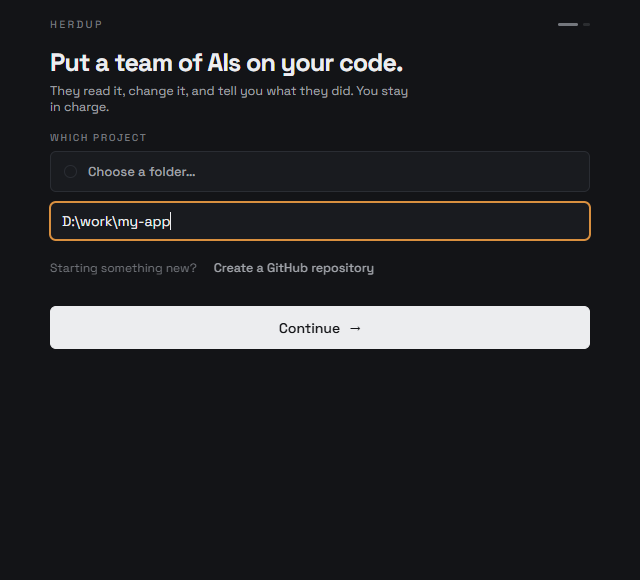
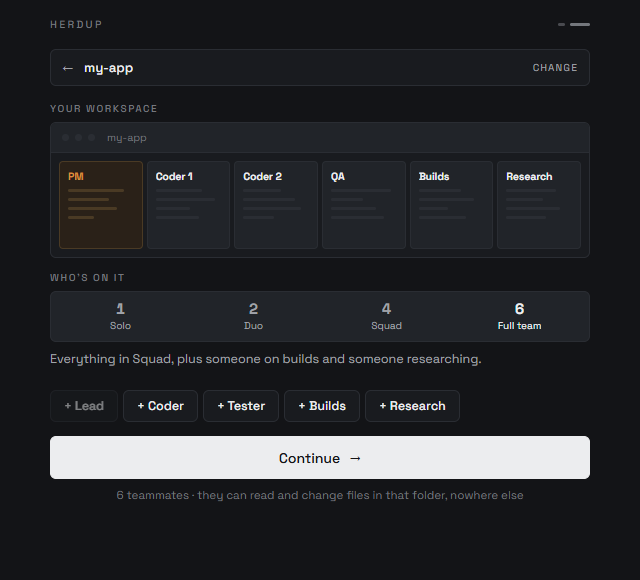
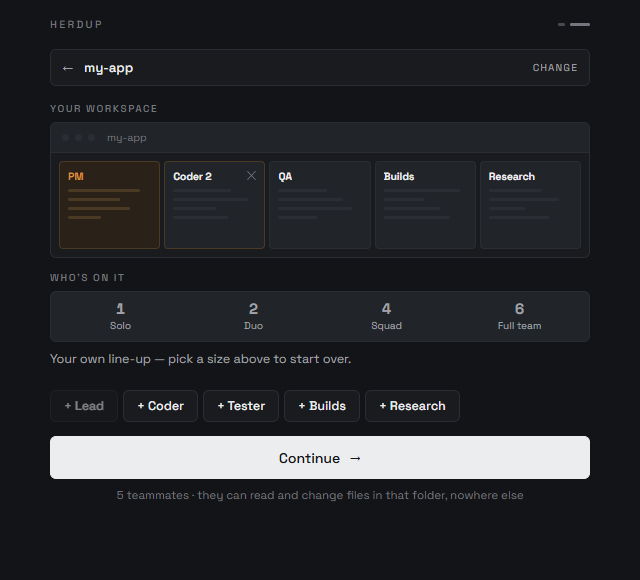
What it’s for
herdup is a launcher, not a wrapper. It does the setup — layout, startup, readiness,
briefing — and then gets out of the way and gives you the terminal. Once your team is
running, herdup is not in the loop and not between you and your tools.
Several projects can run at once. Each launch gets its own workspace, so a team working
on one repo keeps going while you start another.
Requirements
herdr 0.8.2 or newer
herdup drives herdr, the terminal
multiplexer that actually runs the agents. It must be installed and on your PATH.
herdup checks the version and refuses to launch against anything older, because it
relies on herdr’s agent API.
At least one agent CLI
herdup starts tools you already have; it does not bundle or resell them. You need at
least one of the tools below installed and signed in. Their subscriptions and API
costs are between you and them.
git, strongly recommended
Not required, but these agents edit files. Without version history there is no undo,
and herdup will warn you every time.
A terminal
Windows Terminal on Windows (PowerShell as a fallback), Terminal.app on macOS, or
whatever x-terminal-emulator points at on Linux.
Supported tools
Any of these can fill any role on a team. herdup knows each one’s command, its permission
flags, and whether it can be briefed unattended.
- Claude Code
- Codex
- Gemini CLI
- Cursor Agent
- GitHub Copilot CLI
- Droid
- Amp
- opencode
- Cline
- Devin CLI
- Grok CLI
- Kimi Code CLI
- Kilo Code CLI
- Kiro CLI
- Qwen Code
- Qoder CLI
- Antigravity CLI
- Mastra Code
- Hermes Agent
- agy
- omp
- pi
- maki
- muse
The list lives in a plain registry.toml you can edit, so adding a tool herdup
has never heard of does not require a new build.
One deliberate limitation
herdup only types instructions into an agent unattended when it can reliably tell the
agent is at its prompt rather than sitting behind a dialog. Where that has not been
verified, it holds the instructions and asks you to release them after a look. This
exists because an early version fired a briefing into a tool showing a “trust this
folder?” prompt, and the Enter keypress answered the dialog instead.
Download
Installers are built by CI for each release. Nothing is code-signed yet, so Windows
SmartScreen and macOS Gatekeeper will both warn you on first run.
Honest status: herdup is developed and tested on Windows. The macOS and Linux installers
come from the same CI and the same commit, but nobody has yet run them on a real desktop.
If you try one, please
say what happened.
Support
Bugs and questions
Open an issue on
GitHub. Include your
OS, your herdr version (herdr --version), and which tools were on the
team.
It isn’t finding my tool
herdup looks for each tool’s binary on your PATH and tells you exactly what it looked
for. If yours lives somewhere unusual, edit registry.toml rather than
waiting for a release.
What herdup never does
It does not send your code anywhere, add a service between you and your tools, or
require an account. The only thing that leaves your machine is an optional “create a
GitHub repository” action you have to ask for.